
 Whatsapp
Depreciation in Class 11: Why Assets Lose Value
A simple Class 11 Accountancy guide to understand depreciation, why it is recorded, and how to treat it in accounts.
- 11th
- Study Advice
- Accounts
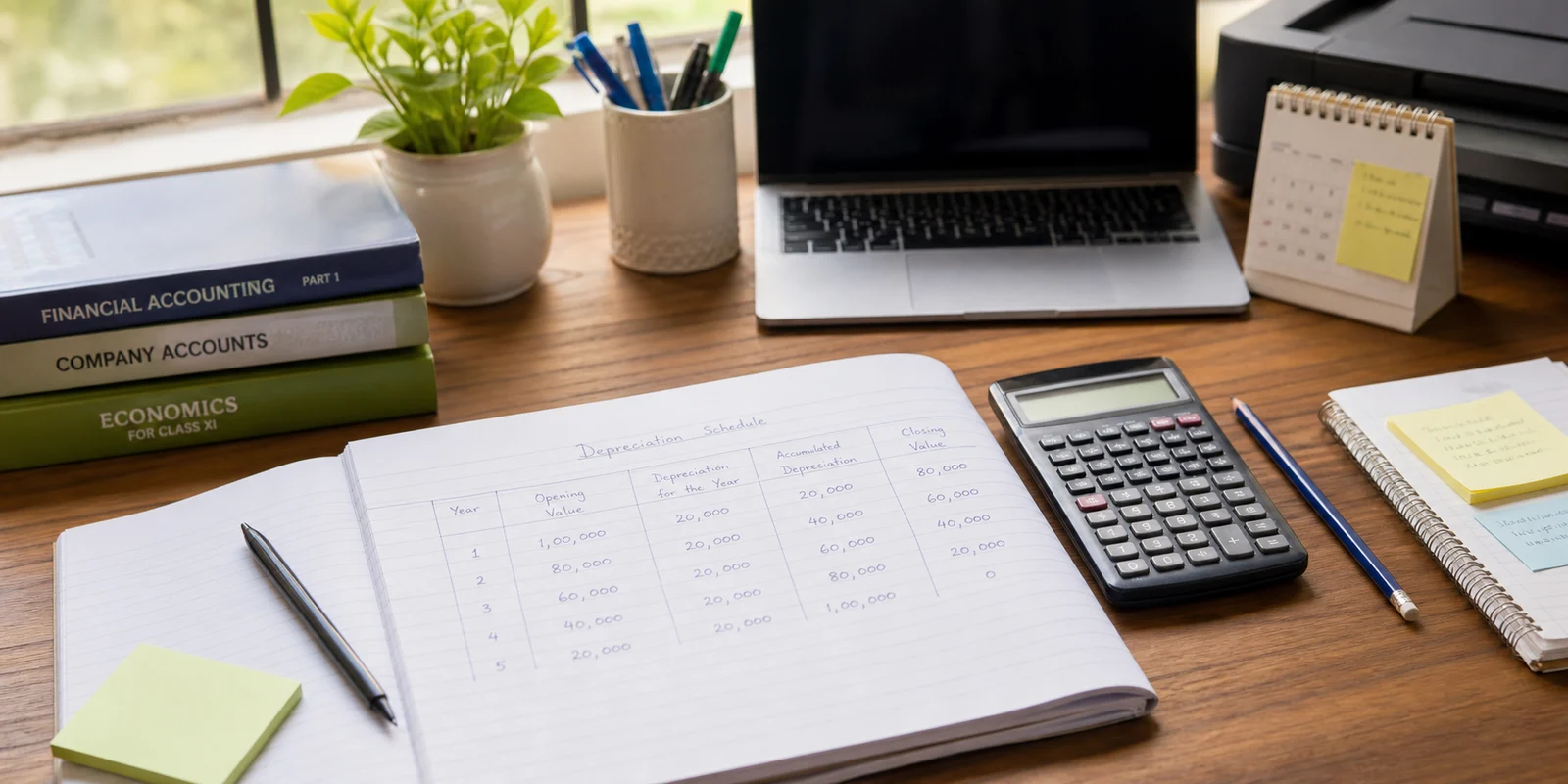
Depreciation is one of those Class 11 Accountancy topics that looks simple at first, then suddenly becomes confusing when journal entries, asset accounts, provision accounts, and Balance Sheet treatment all come together.
The good news is that depreciation is not a difficult idea. It is a very practical idea.
A business buys fixed assets like furniture, machinery, computers, vehicles, or equipment because those assets help the business work for more than one year. But these assets do not stay new forever. They get used, they become older, their usefulness reduces, and sometimes better technology replaces them.
Depreciation is the accounting way of recording that loss in value over time.
This guide explains depreciation in a student-friendly way, with the logic, the methods, the entries, and the common mistakes Class 11 students should avoid.
What Depreciation Means
Depreciation means a fall in the book value of a fixed asset because of use, passage of time, or obsolescence.
Let us make that simple.
Suppose a business buys a computer for Rs. 60,000. The computer will not be used for only one day or one month. It may help the business for several years. So it would not be fair to treat the full Rs. 60,000 as an expense of only the year in which it was bought.
Instead, the cost is spread over the years in which the computer is useful.
That yearly portion is depreciation.
| Term | Simple meaning |
|---|---|
| Fixed asset | Asset used in business for more than one accounting year |
| Depreciation | Part of the asset cost treated as expense for the year |
| Book value | Value of the asset shown in the books after depreciation |
| Useful life | Estimated period for which the asset will be useful |
| Scrap value | Estimated value of the asset at the end of its useful life |
Depreciation is not based on daily market price. It is based on the cost of the asset that has been used up in business.
Why Assets Lose Value
Fixed assets lose value for a few common reasons.
The first reason is wear and tear. A machine used every day in a factory will slowly lose efficiency. A delivery van used regularly will need more repairs as it gets older. Furniture in an office may become loose or damaged over time.
The second reason is passage of time. Even if an asset is not used heavily, it may still become older. A computer kept in an office for years may not remain as valuable as a new one.
The third reason is obsolescence. This means an asset becomes outdated because a newer or better option is available. For example, old computer systems may lose value quickly when newer software and hardware become common.
This is why depreciation is charged every year for assets that have a limited useful life.
Why Depreciation Is Recorded
Students often ask, “If depreciation is not paid in cash every year, why do we record it?”
That is an important question.
Depreciation is a non-cash expense. The business does not pay depreciation to someone every year. But the business has still used part of an asset during the year, and that used-up cost should be recorded.
There are three main reasons for recording depreciation.
First, it helps calculate correct profit. If depreciation is ignored, expenses will be understated and profit will look higher than it really is.
Second, it helps show assets at a more realistic book value. If a machine was bought five years ago, showing it at full original cost without depreciation may not give a fair picture.
Third, it follows the matching idea in accounting. The revenue of a period should be matched with the expenses related to that period. Since a fixed asset helps earn revenue over many years, its cost is also spread over many years.
So even though depreciation does not involve a fresh cash payment, it still affects profit and asset value.
The Three Figures You Need Before Calculating Depreciation
Before solving depreciation questions, identify three figures clearly.
| Figure | Meaning |
|---|---|
| Cost of asset | Purchase price plus expenses needed to bring the asset into use |
| Estimated scrap value | Expected value at the end of useful life |
| Estimated useful life | Number of years the asset is expected to be used |
Cost of asset is not always just the purchase price.
If a machine is purchased for Rs. 1,00,000 and installation costs Rs. 10,000, the cost of the machine for depreciation is Rs. 1,10,000. The installation expense is included because it was necessary to make the machine ready for use.
This small reading habit prevents many wrong answers.
Straight Line Method
The straight line method is also called the fixed instalment method.
Under this method, the same amount of depreciation is charged every year. It is useful when the asset is expected to provide almost equal benefit every year.
The formula is:
Annual depreciation = (Cost of asset - Scrap value) / Useful lifeHere is a simple example.
A machine costs Rs. 1,10,000. Its expected scrap value is Rs. 10,000. Its useful life is 5 years.
Annual depreciation = (1,10,000 - 10,000) / 5
Annual depreciation = 1,00,000 / 5
Annual depreciation = Rs. 20,000
So Rs. 20,000 will be charged every year.
| Year | Depreciation | Closing book value |
|---|---|---|
| 1 | Rs. 20,000 | Rs. 90,000 |
| 2 | Rs. 20,000 | Rs. 70,000 |
| 3 | Rs. 20,000 | Rs. 50,000 |
| 4 | Rs. 20,000 | Rs. 30,000 |
| 5 | Rs. 20,000 | Rs. 10,000 |
The closing book value reaches the scrap value at the end of useful life.
The most common mistake is forgetting to deduct scrap value before dividing by useful life.
Written Down Value Method
The written down value method is also called the reducing balance method or diminishing balance method.
Under this method, depreciation is charged at a fixed percentage on the book value of the asset at the beginning of the year. Since the book value keeps reducing, the amount of depreciation also reduces every year.
Here is a simple example.
A machine costs Rs. 1,00,000. Depreciation is charged at 10 percent per year under written down value method.
| Year | Opening book value | Depreciation at 10 percent | Closing book value |
|---|---|---|---|
| 1 | Rs. 1,00,000 | Rs. 10,000 | Rs. 90,000 |
| 2 | Rs. 90,000 | Rs. 9,000 | Rs. 81,000 |
| 3 | Rs. 81,000 | Rs. 8,100 | Rs. 72,900 |
Notice what is happening. The rate is the same, but the amount is different because the base value changes each year.
This method often makes sense for assets that give higher benefit in earlier years and may need more repairs later.
Do not apply the percentage on original cost every year under written down value method. Apply it on the reduced book value.
How Depreciation Is Recorded
In Class 11, students usually learn two ways of recording depreciation.
The first way is to credit the asset account directly. The second way is to create a Provision for Depreciation Account, also called Accumulated Depreciation Account.
Let us understand both.
When Depreciation Is Credited to the Asset Account
Under this method, the asset account is reduced directly.
The entry for depreciation is:
Depreciation A/c Dr.
    To Asset A/c
Then depreciation is transferred to Profit and Loss Account:
Profit and Loss A/c Dr.
    To Depreciation A/c
After this, the asset appears in the Balance Sheet at reduced value.
For example, if furniture costs Rs. 50,000 and depreciation is Rs. 5,000, the furniture may appear in the Balance Sheet at Rs. 45,000.
When Provision for Depreciation Account Is Created
Under this method, the asset account continues to show original cost. The total depreciation is collected separately in Provision for Depreciation Account.
The yearly entries are:
Depreciation A/c Dr.
    To Provision for Depreciation A/c
Then:
Profit and Loss A/c Dr.
    To Depreciation A/c
In the Balance Sheet, the asset may be shown like this:
| Particulars | Amount |
|---|---|
| Machinery at cost | Rs. 1,00,000 |
| Less: Provision for depreciation | Rs. 20,000 |
| Book value | Rs. 80,000 |
This distinction is very important in ledger questions.
How Depreciation Affects Profit and Balance Sheet
Depreciation has two main effects.
It reduces profit because it is charged to Profit and Loss Account.
It reduces the book value of the asset, either directly or through provision for depreciation.
| Statement | Effect of depreciation |
|---|---|
| Profit and Loss Account | Shown as an expense, so profit reduces |
| Balance Sheet | Asset value reduces or provision is deducted |
This is why depreciation appears in both final accounts and ledger chapters. It connects calculation, journal entries, and financial statement presentation.
If you remember only one effect, the answer may become incomplete.
Common Mistakes Students Make
Depreciation mistakes are usually small, but they change the whole answer.
Here are the ones to watch for:
| Mistake | Better approach |
|---|---|
| Applying WDV rate on original cost every year | Apply it on opening book value each year |
| Forgetting scrap value in SLM | Deduct scrap value before dividing by useful life |
| Treating depreciation as a cash payment | Remember it is a non-cash expense |
| Confusing asset account and provision account | Follow the method given in the question |
| Forgetting Profit and Loss transfer | Close Depreciation Account by transferring it to Profit and Loss Account |
| Ignoring installation or freight costs | Add necessary costs that make the asset ready for use |
This quick check can catch most errors before you move to the next question.
A Simple Practice Routine
Do not revise depreciation only by reading definitions.
This chapter needs written practice.
Start with meaning and causes. Then practise straight line method calculations. After that, practise written down value method. Once calculations feel comfortable, move to journal entries and ledger accounts.
A good order is:
- Learn meaning, causes, and need for depreciation.
- Practise SLM questions with cost, scrap value, and useful life.
- Practise WDV questions with opening book value and rate.
- Write the journal entries without looking.
- Solve one question with direct asset reduction.
- Solve one question with Provision for Depreciation Account.
- Review how the asset appears in the Balance Sheet.
The aim is not to memorise one solved example. The aim is to understand what changes when the question changes.
Read the wording carefully. Depreciation questions reward patient reading.
Final Thought
Depreciation is not just a formula chapter.
It teaches you how accountants think about long-term assets. A business may buy an asset once, but it uses that asset over many years. Depreciation spreads the cost fairly, shows profit more honestly, and presents assets at a more sensible book value.
Once this logic is clear, the methods and entries become much easier to remember.
Frequently Asked Questions
What is depreciation in Class 11 Accountancy?
Depreciation is the fall in the book value of a fixed asset because of use, passage of time, or obsolescence. In accounting, it means spreading the cost of a fixed asset over its useful life.
Is depreciation a cash expense?
No. Depreciation is a non-cash expense. The business does not pay depreciation every year, but it records the cost of using the asset during the year.
Why is depreciation charged to Profit and Loss Account?
Depreciation is charged to Profit and Loss Account because it is an expense of the accounting period. It helps calculate a more correct profit or loss.
What is the difference between straight line method and written down value method?
Under straight line method, the same amount of depreciation is charged every year. Under written down value method, depreciation is charged on the reduced book value, so the amount usually decreases each year.
Does depreciation reduce the value of an asset in the Balance Sheet?
Yes. Depreciation reduces the book value of the asset. This may happen directly through the asset account or indirectly through Provision for Depreciation Account.
What is Provision for Depreciation Account?
Provision for Depreciation Account is used to collect depreciation separately instead of reducing the asset account directly. The asset may continue to appear at original cost, while accumulated depreciation is shown separately or deducted.
What is the most common mistake in depreciation questions?
One common mistake is applying written down value depreciation on original cost every year. In WDV method, the percentage should usually be applied on the opening book value for that year.
Looking for commerce tuitions?
Prachi is a gold-medalist commerce teacher with experience at Deloitte and KPMG. She focuses on fundamentals to build a strong foundation.