
 Whatsapp
Lines and Planes in 3D: Cartesian and Vector Forms Made Simple
Learn how to convert 3D lines and planes between Cartesian and vector forms, read direction and normal vectors, and check every answer.
- 12th
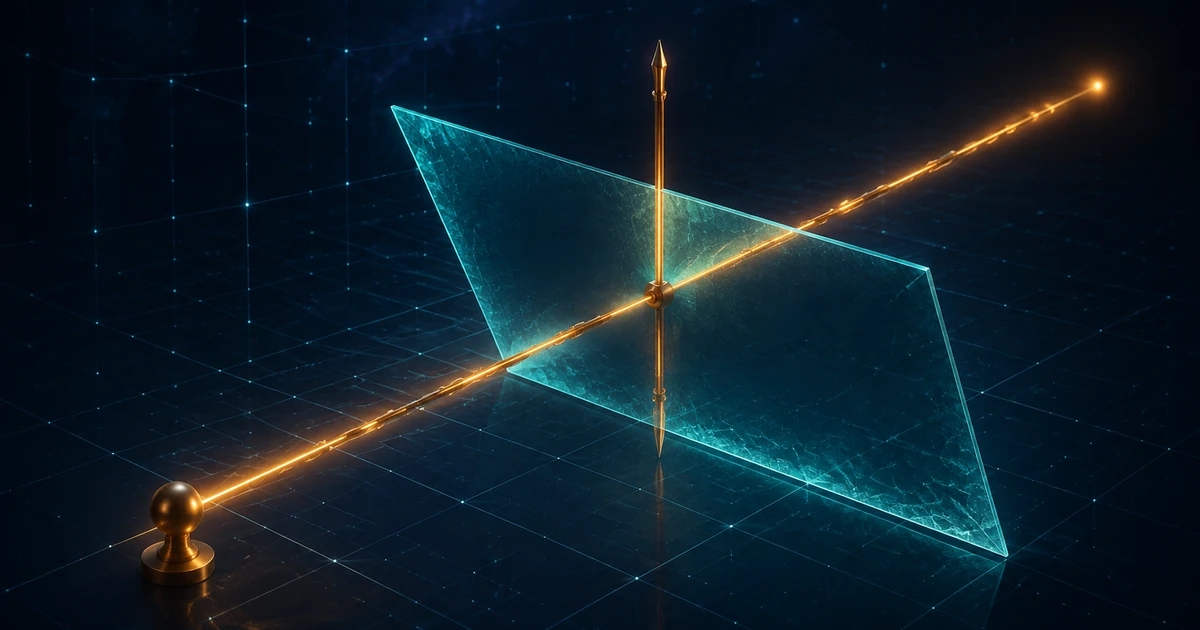
Lines and planes in three dimensions can feel like a crowd of unrelated formulas.
One question gives a vector equation. Another gives three fractions. A third gives a dot product. Then a plane appears as Ax + By + Cz + D = 0, and it may seem as if the chapter has changed its language completely.
It has not.
Every form is describing the same geometry with different words. Once you learn what information each form is carrying, conversion becomes a calm process instead of a memory test.
This guide builds that idea from the ground up, covers the awkward zero-denominator case, and shows how to check an answer before you move on.
If choosing between equation forms in two dimensions still feels uncertain, begin with this straight-line equation guide and then return to the extra z coordinate here.
The Picture Behind Every Equation
Imagine a tiny traveller moving through space.
To describe a straight route, you need two things:
- where the traveller starts
- the direction in which the traveller moves
That gives a line.
Now imagine a large flat sheet suspended in space. To fix its position, you need:
- one point on the sheet
- a vector standing perpendicular to the sheet
That gives a plane.
The perpendicular vector is called a normal vector.
| Object | Fixed by | Vector to look for |
|---|---|---|
| Line | One point and one direction | Direction vector, parallel to the line |
| Plane | One point and one normal | Normal vector, perpendicular to the plane |
The most common mistake in this topic is to mix up those two roles. The vector written with a line points along the line. The vector used in the normal form of a plane points away from the plane at a right angle.
A Small Notation Guide
Let a general point in space be P(x, y, z). Its position vector is:
r = x i + y j + z k
Suppose a fixed point is A(x1, y1, z1). Its position vector is:
a = x1 i + y1 j + z1 k
For a line, let the direction vector be:
d = l i + m j + n k
For a plane, let the normal vector be:
N = A i + B j + C k
Letters vary from book to book. That does not change the method. Focus on the job of each vector, not its name.
Also remember that lambda and mu are simply real-number parameters. As their values change, the position vector r reaches different points on the line or plane.
The Three Useful Forms of a Line
A line through A(x1, y1, z1) with direction ratios l, m, n can be written in three closely connected forms.
Vector form
r = a + lambda d
In full:
r = (x1 i + y1 j + z1 k) + lambda(l i + m j + n k)
This literally says:
current position = fixed point + some multiple of the directionParametric form
Equate the coefficients of i, j, and k:
x = x1 + lambda l
y = y1 + lambda m
z = z1 + lambda n
These are not three separate lines. The same value of lambda must be used in all three equations.
Cartesian or symmetric form
Solve each parametric equation for lambda:
(x - x1)/l = (y - y1)/m = (z - z1)/n
The numerators reveal a point on the line. The denominators reveal direction ratios.
| What you see | What it tells you |
|---|---|
x - x1, y - y1, z - z1 | Point (x1, y1, z1) |
Denominators l, m, n | Direction ratios of the line |
| Common parameter | How far, and in which sense, you move along the direction |
Convert a Line From Vector Form to Cartesian Form
Consider the line:
r = (2i - j + 3k) + lambda(4i + 2j - 3k)
Step 1: Read the fixed point
The fixed part is 2i - j + 3k, so the line passes through:
(2, -1, 3)
Step 2: Read the direction ratios
The coefficient of lambda is 4i + 2j - 3k, so the direction ratios are:
4, 2, -3
Step 3: Write the parametric equations
x = 2 + 4lambda
y = -1 + 2lambda
z = 3 - 3lambda
Step 4: Isolate the same parameter
lambda = (x - 2)/4
lambda = (y + 1)/2
lambda = (z - 3)/(-3)
Therefore, the Cartesian form is:
(x - 2)/4 = (y + 1)/2 = (z - 3)/(-3)
The sign in the last denominator matters. If you prefer a positive denominator there, you must change the sign of its numerator too:
(z - 3)/(-3) = (3 - z)/3
Do not change only one of them.
A ten-second check
Put lambda = 0 in the parametric equations. You should get the fixed point (2, -1, 3). Also compare the three denominators with the three components of the direction vector.
If both checks pass, the conversion is almost certainly correct.
Convert a Line From Cartesian Form to Vector Form
Consider:
(x + 1)/3 = (y - 4)/(-2) = (z - 5)/6
Compare this with:
(x - x1)/l = (y - y1)/m = (z - z1)/n
The numerators give the point:
x + 1meansx - (-1), sox1 = -1y - 4givesy1 = 4z - 5givesz1 = 5
The denominators give the direction ratios 3, -2, 6.
So the vector form is:
r = (-i + 4j + 5k) + lambda(3i - 2j + 6k)
You can also introduce the common value directly:
(x + 1)/3 = (y - 4)/(-2) = (z - 5)/6 = lambda
Then:
x = -1 + 3lambda
y = 4 - 2lambda
z = 5 + 6lambda
These equations make the vector form easy to see.
The Zero-Denominator Trap
The symmetric form assumes that the direction components in the denominators are nonzero. But a perfectly valid line may have a zero direction component.
Consider:
r = (2i + 3j - k) + lambda(4i + 0j + 5k)
Its parametric equations are:
x = 2 + 4lambda
y = 3
z = -1 + 5lambda
The y coordinate never changes. This line is parallel to the xz plane.
You must not write (y - 3)/0. Division by zero is undefined.
Write the Cartesian description as:
(x - 2)/4 = (z + 1)/5, y = 3
This is sometimes called a non-symmetric Cartesian form.
| Zero direction component | Coordinate that stays fixed |
|---|---|
l = 0 | x = x1 |
m = 0 | y = y1 |
n = 0 | z = z1 |
This is one reason parametric form is such a safe bridge. It handles zero components naturally.
Equation of a Line Through Two Points
Suppose a line passes through A(1, 2, -1) and B(4, -2, 5).
The direction vector is found by subtracting coordinates in the same order:
AB = (4 - 1)i + (-2 - 2)j + (5 - (-1))k
So:
AB = 3i - 4j + 6k
Using point A, the vector equation is:
r = (i + 2j - k) + lambda(3i - 4j + 6k)
The Cartesian equation is:
(x - 1)/3 = (y - 2)/(-4) = (z + 1)/6
Could you use BA instead? Yes.
BA = -3i + 4j - 6k
That reverses the direction but traces the same line. The parameter simply runs in the opposite sense.
A Line Can Also Appear as Two Plane Equations
This is an important piece of three-dimensional thinking:
Ax + By + Cz + D = 0
is one equation in three variables, so it normally describes a plane, not a line.
A line may be described by two independent plane equations because two nonparallel planes meet in a line.
Consider:
x + y + z = 2
2x - y + z = 1
The normal vectors of the planes are:
N1 = i + j + k
N2 = 2i - j + k
The intersection line lies in both planes. Its direction must therefore be perpendicular to both normals. Use their cross product:
N1 x N2 = 2i + j - 3k
So a direction vector is (2, 1, -3).
Now find one point common to both planes. Set z = 0 for convenience:
x + y = 2
2x - y = 1
Adding gives 3x = 3, so x = 1 and y = 1. A common point is (1, 1, 0).
Therefore, the vector equation of the intersection line is:
r = (i + j) + lambda(2i + j - 3k)
And its symmetric form is:
(x - 1)/2 = (y - 1)/1 = z/(-3)
Check the direction without trusting the cross product
Take dot products with the two normals:
(2, 1, -3) . (1, 1, 1) = 2 + 1 - 3 = 0
(2, 1, -3) . (2, -1, 1) = 4 - 1 - 3 = 0
The direction is perpendicular to both normals, as it should be.
The Main Forms of a Plane
A plane through point A with position vector a and normal vector N has the vector equation:
(r - a) . N = 0
Why does the dot product equal zero?
For any point P on the plane, r - a represents the vector AP. That vector lies within the plane. The normal vector stands perpendicular to every direction in the plane, so:
AP . N = 0
The same equation can be rearranged:
r . N = a . N
If:
N = A i + B j + C k
then the Cartesian equation becomes:
A(x - x1) + B(y - y1) + C(z - z1) = 0
or, after expansion:
Ax + By + Cz + D = 0
The coefficients A, B, C are direction ratios of the plane’s normal.
| Plane form | What it displays clearly |
|---|---|
(r - a) . N = 0 | A point and a normal |
r . N = d | Normal and constant dot product |
Ax + By + Cz + D = 0 | Direct coordinate condition |
r = a + lambda u + mu v | A point and two independent directions within the plane |
Convert a Plane From Vector Form to Cartesian Form
Consider:
(r - (i - 2j + 3k)) . (2i + j - 4k) = 0
Step 1: Read the point and normal
The plane passes through (1, -2, 3).
Its normal vector is (2, 1, -4).
Step 2: Replace the vector difference by components
r - a = (x - 1)i + (y + 2)j + (z - 3)k
Step 3: Take the dot product
2(x - 1) + (y + 2) - 4(z - 3) = 0
Step 4: Simplify carefully
2x - 2 + y + 2 - 4z + 12 = 0
Therefore:
2x + y - 4z + 12 = 0
Check the fixed point
Substitute (1, -2, 3):
2(1) + (-2) - 4(3) + 12 = 0
The point satisfies the equation. Also, the first three coefficients 2, 1, -4 match the normal vector.
These two checks catch most expansion errors.
Convert a Plane From Cartesian Form to Vector Form
Consider:
3x - 2y + 6z - 12 = 0
Step 1: Read the normal vector
The coefficients of x, y, z give:
N = 3i - 2j + 6k
Step 2: Move the constant
3x - 2y + 6z = 12
Since r = xi + yj + zk, the left side is r . N.
Therefore, a compact vector equation is:
r . (3i - 2j + 6k) = 12
That answer is already complete.
If you want point-normal form, find any convenient point on the plane. Set y = 0 and z = 0. Then 3x = 12, so x = 4. The point (4, 0, 0) lies on the plane.
Hence:
(r - 4i) . (3i - 2j + 6k) = 0
Both vector equations describe the same plane.
Do Not Confuse General Form With Normal Form
The equation:
Ax + By + Cz + D = 0
has normal vector (A, B, C), but that vector is not necessarily a unit vector.
The unit-normal form is:
r . N-hat = p
where N-hat has magnitude 1 and p is the perpendicular distance of the plane from the origin. Usually, choose the sign so that p is nonnegative.
To convert a general Cartesian equation into unit-normal form, divide by:
sqrt(A^2 + B^2 + C^2)
and choose the overall sign carefully.
For example:
2x - 2y + z - 9 = 0
becomes:
(2/3)x - (2/3)y + (1/3)z = 3
because sqrt(2^2 + (-2)^2 + 1^2) = 3.
Here the unit normal is (2/3, -2/3, 1/3) and the distance from the origin is 3.
This is a normalization step, not merely moving the constant to the other side.
A Plane Can Also Use Two In-Plane Directions
Another valid vector description of a plane is:
r = a + lambda u + mu v
Here:
ais the position vector of one fixed pointuandvare two nonparallel vectors lying in the planelambdaandmucan vary independently
One direction is enough for a line. A plane needs two independent in-plane directions.
Consider:
r = (i + 2j - k) + lambda(2i - j + 3k) + mu(i + 4j)
The fixed point is (1, 2, -1). The two in-plane directions are:
u = (2, -1, 3)
v = (1, 4, 0)
To find a normal vector, take the cross product:
u x v = (-12, 3, 9)
Divide by 3 to simplify:
N = (-4, 1, 3)
Now use point-normal form:
-4(x - 1) + (y - 2) + 3(z + 1) = 0
After simplification:
-4x + y + 3z + 5 = 0
You may multiply the whole equation by -1 and write:
4x - y - 3z - 5 = 0
They are the same plane.
Equation of a Plane Through Three Points
Suppose a plane passes through:
A(1, 0, 2), B(3, 1, 1), and C(0, 2, 4)
Step 1: Find two vectors in the plane
AB = (2, 1, -1)
AC = (-1, 2, 2)
Step 2: Find a normal
N = AB x AC
This gives:
N = (4, -3, 5)
Step 3: Use any of the three points
Using A(1, 0, 2):
4(x - 1) - 3(y - 0) + 5(z - 2) = 0
So:
4x - 3y + 5z - 14 = 0
The vector normal form is:
(r - (i + 2k)) . (4i - 3j + 5k) = 0
The two-direction vector form is:
r = (i + 2k) + lambda(2i + j - k) + mu(-i + 2j + 2k)
All three equations describe the same plane.
Check all three points
For A(1, 0, 2):
4 - 0 + 10 - 14 = 0
For B(3, 1, 1):
12 - 3 + 5 - 14 = 0
For C(0, 2, 4):
0 - 6 + 20 - 14 = 0
Every point satisfies the equation.
One Worked Problem That Uses Both Objects
Find where the line
(x - 1)/2 = (y + 1)/3 = (z - 2)/(-1)
meets the plane:
x + y + z = 6
Step 1: Convert the line to parametric form
Set the common ratio equal to lambda:
x = 1 + 2lambda
y = -1 + 3lambda
z = 2 - lambda
Step 2: Substitute into the plane
(1 + 2lambda) + (-1 + 3lambda) + (2 - lambda) = 6
2 + 4lambda = 6
So:
lambda = 1
Step 3: Find the point
x = 3, y = 2, z = 1
The line meets the plane at (3, 2, 1).
Step 4: Verify independently
The point satisfies the plane because:
3 + 2 + 1 = 6
It also satisfies all three line ratios:
(3 - 1)/2 = (2 + 1)/3 = (1 - 2)/(-1) = 1
This final check proves that the point belongs to both objects.
A Conversion Decision Map
Use this table when you are unsure how to start.
| Given | Required | First move |
|---|---|---|
| Line in vector form | Cartesian line | Equate i, j, k components, then eliminate lambda |
| Line in Cartesian symmetric form | Vector line | Read point from numerators and direction from denominators |
| Two points on a line | Either line form | Subtract coordinates to get a direction vector |
| Two plane equations | Their intersection line | Cross the normals for direction, then find one common point |
| Plane in point-normal vector form | Cartesian plane | Expand the dot product |
| Plane in general Cartesian form | Vector plane | Read the normal from coefficients and move the constant |
| Plane in two-direction vector form | Cartesian plane | Cross the two directions to get a normal |
| Three points on a plane | Either plane form | Form two in-plane vectors, then cross them |
The order is deliberate. First extract the geometry. Only then do the algebra.
Why Different Answers Can Still Be Correct
The same line or plane can have many correct equations.
For a line:
- you may choose any point on the line as the fixed point
- you may replace the direction vector by any nonzero scalar multiple
- you may use a different parameter letter
For a plane:
- you may choose any point on the plane
- you may replace the normal vector by any nonzero scalar multiple
- you may multiply the entire Cartesian equation by a nonzero constant
For example:
2x + y - 4z + 12 = 0
and:
-6x - 3y + 12z - 36 = 0
describe the same plane because the second equation is the first multiplied by -3.
Do not reject an answer just because its numbers look different. Check whether the direction or normal vectors are proportional and whether a known point satisfies both equations.
Common Mistakes and How to Catch Them
1. Reading the wrong point from a numerator
From x + 4, the coordinate is -4, not 4.
Rewrite it mentally as x - (-4).
2. Treating plane coefficients as an in-plane direction
In Ax + By + Cz + D = 0, the vector (A, B, C) is normal to the plane.
3. Putting zero in a denominator
If a line has a zero direction component, write the corresponding coordinate as a constant.
4. Using different parameter values for x, y, and z
All three parametric equations of one line use the same lambda.
5. Subtracting points in mixed orders
If you calculate B - A, subtract every coordinate as B coordinate - A coordinate. Do not reverse only one component.
6. Expanding the dot product too quickly
Write the point differences first. In particular, if y1 = -2, then y - y1 = y + 2.
7. Forgetting that a single linear equation in 3D is a plane
A line in space normally needs a parameter, a symmetric chain, or two independent linear equations.
8. Using two parallel directions for a plane
The two vectors in r = a + lambda u + mu v must not be parallel. Their cross product should be nonzero.
9. Normalizing when it is not required
Direction ratios and normal ratios need not have magnitude 1. Normalize only when the question asks for direction cosines, a unit vector, or unit-normal form.
10. Skipping the substitution check
A single substitution often finds a lost sign faster than rereading a full solution.
A Reliable Five-Step Answer Pattern
When solving a conversion question, use this order:
- Identify whether the object is a line or a plane.
- Extract the fixed point.
- Identify the direction vector or normal vector.
- Convert through component or dot-product form.
- Check one known point and the vector relationship.
This pattern keeps the geometry visible even when the algebra becomes long.
Quick Practice
Try these without looking at the answers immediately.
Question 1
Convert to Cartesian form:
r = (3i - 2j + k) + lambda(2i + 5j - 4k)
Question 2
Convert to vector form:
(x - 4)/3 = (y + 2)/(-1) = (z - 5)/2
Question 3
Write a valid Cartesian description of:
r = (i + 4j - 2k) + lambda(3i + 0j - k)
Question 4
Convert the plane to Cartesian form:
(r - (2i + j - k)) . (i - 3j + 2k) = 0
Question 5
Write a vector equation of the plane:
2x + y - 2z + 7 = 0
Question 6
Find the Cartesian equation of the plane through (1, 1, 0) with in-plane directions (1, 2, 1) and (2, 1, -1).
Answers to Quick Practice
(x - 3)/2 = (y + 2)/5 = (z - 1)/(-4)r = (4i - 2j + 5k) + lambda(3i - j + 2k)(x - 1)/3 = (z + 2)/(-1), y = 4x - 3y + 2z + 3 = 0r . (2i + j - 2k) = -7- The two in-plane directions have cross product
(-3, 3, -3), which simplifies to normal(1, -1, 1). The plane isx - y + z = 0.
Further Reading
- Three Dimensional Geometry, Mathematics Part II develops the point-and-direction form of a line and its Cartesian conversion.
- Equations of Lines and Planes in Space connects vector, parametric, and symmetric line equations with point-normal plane equations.
- MIT OpenCourseWare notes on equations of planes give a concise geometric explanation of the normal vector.
Frequently Asked Questions
What is the fastest way to convert a line from vector form to Cartesian form?
Write the three parametric component equations and solve each for the same parameter. Equating those expressions gives the symmetric Cartesian form.
How do I identify a point from the Cartesian equation of a line?
Compare each numerator with x - x1, y - y1, and z - z1. For example, y + 3 means y - (-3), so the y-coordinate is -3.
What do the denominators in the Cartesian equation of a line represent?
They are direction ratios of the line. They are proportional to the components of any direction vector parallel to the line.
What should I do if one direction ratio is zero?
Do not divide by zero. Write the corresponding coordinate as a constant and use the symmetric ratio only for the changing coordinates.
Is Ax + By + Cz + D = 0 a line or a plane in three dimensions?
It normally describes a plane. Its normal vector is (A, B, C). A line can be described as the common intersection of two independent plane equations.
How do I identify the normal vector of a plane?
In Ax + By + Cz + D = 0, the normal vector is Ai + Bj + Ck. In (r - a) . N = 0, it is the vector N used in the dot product.
Why is the dot product zero in the vector equation of a plane?
The vector from the fixed point to any other point in the plane lies within the plane. It is perpendicular to the normal vector, so their dot product is zero.
Are r . N = d and (r - a) . N = 0 the same form?
Yes, when d = a . N. Expanding the second equation gives r . N - a . N = 0, which rearranges to the first.
Can two different vector equations represent the same line?
Yes. They may use different points on the line, proportional direction vectors, or different parameter letters. Test whether the direction vectors are parallel and whether a point from one equation lies on the other line.
Can I multiply a plane equation by a constant?
Yes, by any nonzero constant. Every term must be multiplied, including the constant term. The set of points satisfying the equation remains unchanged.
How do I convert a plane with two direction vectors into Cartesian form?
Take the cross product of the two nonparallel in-plane directions to obtain a normal vector. Then use that normal with the fixed point in point-normal form and expand.
What is the safest final check for a converted equation?
Substitute a known point. For a line, also verify the direction ratios. For a plane, verify that the first three Cartesian coefficients are proportional to the normal vector.
Looking for commerce tuitions?
Prachi is a gold-medalist commerce teacher with experience at Deloitte and KPMG. She focuses on fundamentals to build a strong foundation.